Suicidal Empathy Is Colorblind: Ask the Author of the 1619 Project

Activist New York Times journalist Nikole Hannah-Jones made news in 2019 as principal author of the error-ridden, Times-produced 1619 Project, which erroneously dates America’s founding from the arrival of the first slaves on our continent’s shores and falsely describes our country’s founding mainly as a project to preserve slavery. Hannah-Jones’s fanciful racialization of our national past, perhaps inspired by her revealing early-life comment that the “white race is the biggest murderer, rapist, pillager and thief of the modern world,” drew sharp rebukes from professional historians of all political stripes, and even from some of her own colleagues at the Times, which initially stood by the author and her flawed work but later issued a series of halting and dilatory corrections.

Nevertheless, the 1619 Project was a great career boon for Hannah-Jones, who had already obtained employment at the former paper of record and, in 2017, was awarded a lucrative MacArthur Fellowship. Her introductory essay to the 1619 Project won her the 2020 Pulitzer Prize for Commentary. A year later, she was elected to the once-prestigious American Academy of Arts and Sciences. A generously endowed tenured professorship in “Race and Journalism” and center directorship at historically black Howard University quickly followed, despite her having neither received a doctorate nor previously taught as a university faculty member. The 1619 Project went on to inform curricula in thousands of school districts.

Over this past weekend, however, Hannah-Jones descended from the Olympian heights of minority privilege to make a startling admission in the pages of the Times’ magazine. “These days,” she wrote of her teenaged daughter Najya, “I feel that I failed both my values and my child . . . by not choosing the ‘best’ school for her.” Despite considering her family “upper-middle class,” thanks to her husband’s access to integrated military schools and her own racially mixed parents’ availing of integration measures to send her to a predominantly white school, Hannah-Jones consigned Najya to New York City Public School 307, whose poor, troubled, and predominantly black student body has caused it to become known as “Little Rikers Island”—named for New York City’s infamous prison, which is allegedly so bad that it is slated to be decommissioned. According to a Manhattan Institute investigation, P.S. 307 spends about $52,000 per student every year despite alarmingly poor academic results.

As well-paid, nationally famous professionals, who in 2018 reportedly paid $1.5 million for a brownstone house in Brooklyn’s hip Bedford-Stuyvesant neighborhood, the Hannah-Joneses might have sent Najya to a much better school, public or private, or at least one that used its resources more judiciously. But they chose not to, in the belief that sending their only child to P.S. 307 would strike a blow for social justice and encourage other progressive parents to do the same. “We thought by sending Najya to a mostly low-income and Black school, we could help improve it for all the children there,” Hannah-Jones condescendingly reflects, as though her family’s mere presence in the impoverished school’s community would work on it like some sort of educational fertilizer. As recently as 2024, the The New York Post reported, she wrote that after eight years of watching P.S. 307 underserve her daughter, “I still know we made the right choice.”

Najya, whom Hannah-Jones claims is an honors student, appears to disagree, showing impressive powers of analysis and insight. “So you had money to send me to one of the best schools, and you chose not to?” her mother reports hearing from her after a disheartening school pickup. To grind salt into the wound, Najya, now entering high school and, presumably, looking forward to college, appears to have rejected her parents’ values. She chose to attend a competitive secondary institution that requires an entrance examination, rather than continue in circumstances that force her to cosplay her parents’ social justice fantasies.

Hannah-Jones clearly has a great deal of guilt emerging from the cognitive gap between her theory and her praxis. Perhaps the best lesson might have been learned by Najya, whom Hannah-Jones quotes in her Times piece saying, “Sometimes I wish instead of always thinking about other kids, you would have thought about me. I never really got the education I wanted.” If those are her true feelings, Najya’s resentment could plague the Hannah-Jones family for decades to come. After all, her parents’ choice was not driven by poverty, ignorance, or misfortune but by a deliberate indulgence in ideology at the expense of opportunity and bloodline success—and it was made when Najya was at a stage in life when she was too young to do or say anything about it.

In the privacy of their posh urban digs, Hannah-Jones may be cynical enough to try to convince Najya that her reduced educational opportunities boosted her mother’s public image, thus bringing far greater resources to their family. It is conceivable that Najya could accept that counterintuitive reasoning and buy into a corrupt and self-perpetuating system that benefits her, especially if 10 years of suffering through P.S. 307 helped her mother access enough income to endow her with a handsome trust fund.

Or, if she is as bright as Hannah-Jones’s confession makes her seem, she could follow the path her mother describes to its natural conclusion, see through its hypocrisy, fully reject her parents’ values, and become a conservative. We should welcome her.
Florida Democrats Could Succumb to Socialism

Chronicles – Socialism’s march through the Democratic Party continued in the least expected of places last Tuesday, as Florida’s Democratic U.S. Senate hopeful, establishment darling, and Trump impeachment witness Alexander Vindman was crushed by little-known Democratic State Representative Angie Nixon.  Nixon, a self-described democratic socialist who wants Medicare for all, the abolition of ICE, and an end to all support for Israel, holds to all of these positions while also saying in a video posted on X that drag shows are “wholesome entertainment” for her children.

Earlier this year, Nixon, who will challenge incumbent Republican Senator Ashley Moody for the Senate seat held until last year by Secretary of State Marco Rubio, burnished her radical image by attempting to disrupt the state legislature’s vote on congressional redistricting, denouncing the measure with a megaphone while dressed in a pink jump suit. In May, she was arrested during a sit-in at Florida Governor Ron DeSantis’s office to protest the measure. And perhaps fatally among Florida’s heavily anti-communist Hispanic electorate, on Aug. 13 her backers, the Democratic Socialists of America, released a statement celebrating the centennial of Fidel Castro’s birth.

Vindman, a national celebrity for his infamous opposition to President Trump, moved to Fort Lauderdale in 2023 and launched a campaign centered on “affordability.” He has raised a reported $16.3 million to Nixon’s paltry $975,000—a sum so low that she apparently could not afford a single television ad. Vindman seems to have been so confident of victory that he refused to debate Nixon throughout the primary and appears to have planned a post-primary fundraiser on Nantucket to support what he likely presumed would be his continuing campaign for the general election. Yet he lost.

Nixon crushed him by 12 points in what the Hill called “the biggest upset of the year”—so far at least—and what President Trump hailed on social media as “the most gratifying loss last night.”

Florida Democrats, in the wake of this upset, are struggling to find a path forward. They have ceased to hold any statewide office. Their 300,000 registered voter advantage in 2018 has vanished and been replaced by a 1.5 million Republican advantage. In addition to all state offices, Republicans hold both of Florida’s Senate seats, 20 of its 28 House seats, and supermajorities in both houses of the state legislature. In Jan. 2023, at the height of his popularity, DeSantis memorably called the state Democratic Party a “dead, rotten carcass on the side of the road.”

With nowhere to go but up, the return to relevance has been a winding road for Florida Democrats. Earlier this year, a handful of Democratic candidates prevailed in off-year state and local elections, where moderation, a focus on affordability that mirrored Vindman’s, and, in some cases, military service records were prominently featured in their campaigns. In the absence of strong or united Republican opposition, several Democratic hopefuls prevailed in contests that drew national attention, including mayoral elections in Miami and Boca Raton, the Florida house district that includes Mar-a-Lago, and a state senate seat vacated by Republican Jay Collins, who left to become the state’s lieutenant governor.

Some Florida Democrats are also hedging against their party’s socialist trend. The Democratic nominee for the governor’s race to succeed DeSantis, David Jolly, is a former Republican congressman who only became a Democrat last year. In a joint CNN interview rebroadcast by Breitbart, incumbent congressmen Jared Moskowitz and Debbie Wasserman Schultz denounced the democratic socialist drift in their party and pledged to resist it. “I reject the DSA,” Wasserman Schultz said, “I reject the fringe left socialism that they are promoting.”

Moskowitz, who is one of only four incumbent Democrats nationally whose district is rated as a “toss up” by the Cook Political Report, leaned centrist to win a decisive primary victory over democratic socialist Oliver Larkin. Larkin had attacked Moskowitz as “DeSantis Democrat” because of the congressman’s reputation for bipartisanship and his acceptance of state and county-level administrative appointments from DeSantis. In his revised district, which leans redder than his old one, that may not be enough to head off Scott Singer. Moskowitz faces the popular former mayor of Boca Raton who won the GOP’s nomination for the district.

In spite of this growing red trend, however, some Florida Democrats are clinging to the socialist label. Many remember that Andrew Gillum, the former mayor of Tallahassee who was DeSantis’s Democratic opponent for governor in 2018, held far-left positions and was often described as a democratic socialist. He lost, but only by 32,000 votes. Wasserman Schultz, a white incumbent who switched districts this year to a new formation that includes a large black population, was widely criticized by fellow Democrats for competing against black candidates. She ultimately won by a plurality over four black opponents who divided most of the ballots, but the ideology was clear. Elijah Manley, a democratic socialist challenger for the district nomination, said Wassserman Schultz “stabbed us in the back, trying to take away Black representation” by which, presumably, he just means that she is white and presumed to run anyway.

Energized by her primary victory, Nixon shows no sign of slowing down as November approaches. “I’ve unseated incumbents before. I’ve been outspent 5-to-1,” she said the morning after her victory in an MSNOW interview quoted by the Hill, “Ashley Moody will be calling me ‘senator’ in November.” Nixon’s path to victory will be difficult in this red state, but she will have some help on the campaign trail—Alexander Vindman has announced that he “will be standing by her side in the fight against Ashley Moody.”

The American Association of University Professors Embraces the Far Left

City Journal – Its endorsement of Abdul El-Sayed in Michigan’s Senate race caps the AAUP’s gradual transformation from a professional organization into a partisan one.

On July 31, the American Association of University Professors announced its “first-ever national electoral endorsement,” putting its weight behind Abdul El-Sayed’s bid for the Democratic Party nomination in Michigan’s 2026 senate race. The endorsement marked a dramatic transformation for the 111-year-old national organization for college and university faculty members—from a professional association that advocates for academic freedom and other professional rights to a radical-left activist group that seems determined to play an explicitly partisan role in national politics.

The AAUP’s endorsement of El-Sayed—an AAUP member and “former teacher” who on August 4 narrowly defeated the more moderate Michigan Representative Haley Stevens in the Democratic primary—already says enough. Though El-Sayed has disavowed the “socialist” label embraced by a rising generation of Democrats, his policies place him decidedly on his party’s far left wing. He favors Medicare for all, wants to abolish ICE, advocates tax hikes, and opposes military aid to Israel, Saudi Arabia, Jordan, and his parents’ native Egypt—all U.S. allies. He campaigned for the Democratic nomination with New York Representative Alexandria Ocasio-Cortez and the DSA-aligned streamer Hasan Piker, who has praised Mao Zedong, lamented the collapse of the Soviet Union, and opined that “America deserved 9/11.”

According to the Washington Free Beacon, El-Sayed’s father-in-law Jukaku Tayeb, who contributed heavily to a PAC connected to his campaign, is also a longtime donor and member of the Founders Committee of the Islamic Society of North America (ISNA) and a past president and current board member of Michigan’s chapter of the Council on American-Islamic Relations (CAIR). The Justice Department named both groups as unindicted co-conspirators in a 2007 criminal case in which the defendants—founders of a supposed “relief organization”—were convicted of illegally funneling $12 million to Hamas.

The AAUP apparently overlooked these controversial associations on the theory that “El-Sayed will be an invaluable ally for academic freedom and higher education as a public good” and praised him for having “vowed to stand up to the Trump administration’s ideological assault on the sector and defend the rights of students and faculty to speak out on political issues.”

The AAUP decided to enshrine its own politicization in June, when it says members attending its biennial meeting “unanimously” adopted a package of resolutions “to help better position the union to build power to win the future of higher education and democracy.” The resolutions included a determination to “support and participate in coordinated political and public campaigns” intended “to resist authoritarian policies.” That directive identifies such policies as coming only from one direction. “Right-wing political actors,” it declares, “are advancing coordinated efforts to undermine democratic institutions, restrict voting rights, weaken labor protections, and erode public trust in knowledge-producing institutions,” among which it believes higher education is a “central target.”

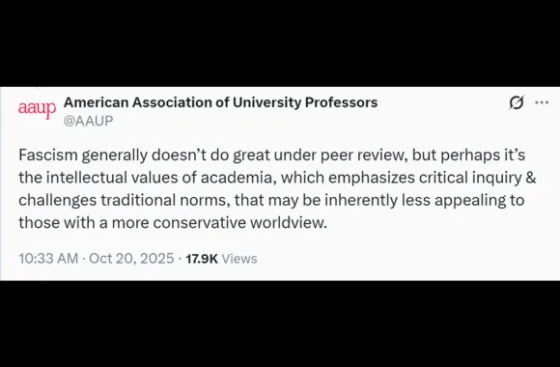
AAUP’s repositioning as a radicalized political group has been years in the making. In August 2024, the organization reversed its long-standing opposition to academic boycotts based on “political or religious viewpoint”—virtually all of which target Israel—bizarrely concluding that merely opposing such boycotts as a matter of policy “contravenes academic freedom.” Former AAUP president Cary Nelson denounced the decision in the Chronicle of Higher Education, worrying that the AAUP had “set aside its hundred-year defense of academic freedom” and proclaimed that “we must no longer use AAUP policy as the gold standard” for the concept it had spent a century defending on at least a nominally apolitical basis. In October 2025, the AAUP’s official X account sarcastically posted that “fascism generally doesn’t do great under peer review” in response to musings on why there are so few conservative academics. That same month, the Foundation for Individual Rights and Expression (FIRE) released a survey suggesting heavy political bias in how faculty unions like the AAUP address complaints alleging free-speech violations: only 7 percent of conservative faculty members reported receiving support in such cases, compared with 29 percent of liberal academics.

Earlier this year, the AAUP’s Isaac Kamola, who leads its Center for the Defense of Academic Freedom, said in a leaked audio recording about the many recently created civics institutes that he wants “to strategically map who these f—ers are, and figure out what the weaknesses are, and design a research agenda that just goes through them and tries to knock them out.” So much for the free marketplace of ideas.

Will the AAUP’s politicization move the needle in a divided nation as it hurdles toward contentious midterm elections in November? It may be too early to tell, but its late-hour endorsement of El-Sayed, who was expected to trounce Stevens yet prevailed by fewer than 16,000 votes, didn’t appear to sway the public, and that’s no surprise: only 38 percent of those surveyed express strong confidence in higher education, according to a Lumina Foundation and Gallup poll released in July.

The AAUP’s involvement may even have hurt El-Sayed’s chances. His Republican opponent Mike Rogers, a former congressman who narrowly lost to Elissa Slotkin in 2024 and won this year’s GOP Senate nomination unopposed, consistently trailed both El-Sayed and Stevens in pre-primary polling. The first post-primary poll, however, gives Rogers a four-point edge.

Mamdani’s Tax List Is an Invitation for Class War and Violence

Chronicles – New York City mayor and Democratic Socialist Zohran Mamdani admonished his city’s property owners in a recent X post, saying owners of second homes worth $5 million or more will have to pay a new “pied-à-terre” tax.

“Check your mailbox when you’re back in the five boroughs—because you’ve got mail,” he wrote.

The “mail” to which Mamdani referred is an official letter from the city about the new tax that Mamdani says he needs to assess because of the city’s troubled budget.

Mamdani’s comment was not entirely accurate, however. The new pied-à-terre tax, which New York Governor Kathy Hochul announced in April, applies not only to $5 million “luxury properties,” but also to co-ops and condominiums worth just $1 million or more—which is not a high ceiling in New York’s inflated real estate market. In Manhattan, both average and median apartment prices in 2025 were estimated to be nearly twice that amount, according to the real estate firm Brown Harris Stevens. That means that virtually all nonresident owners of places larger than a small studio apartment will qualify for the new tax.

The Mamdani administration has gone far beyond punitive fiscal measures, which the mayor claimed would be confined to extremely rich individuals like hedge fund billionaire Ken Griffin. (Mamdani famously taunted Griffin in an X video on April 15—tax day—about taxing the “richest of the rich.”) On July 27, New York’s Department of Finance published a searchable list available to the general public of city property owners who it says may qualify for the tax.

Initially, according to an April public announcement from Gov. Hochul, the tax was only meant to apply to only about 13,000 people, and there was no indication that their identities or addresses would be disclosed to the general public. The Finance Department’s list, however, contains more than 960,000 properties and the full names and addresses of their owners. According to an analysis by The New York Post, many individuals who appear on the list may not, in fact, be liable for the tax. Some appear to inhabit the listed properties as primary residences, while some listed properties are in neighborhoods where average values are under the $1 million tax threshold. Still other properties appear to be commercial real estate and thus not “residences” that might otherwise be liable for the new tax.

Regardless of their tax liabilities, residence statuses, and individual net worths, all of the people on Mamdani’s list have been “doxxed,” that is, publicly identified with private information in a government register indicating where they live.

While the imposition of the pied-à-terre tax may or may not ultimately force all of them to pay more for their city dwellings, the list’s mere existence suggests that the people on it are members of a suspect class of citizens—deserving of both higher taxes and public shaming. This categorization and doxxing recalls the Soviet Union’s treatment of “the possessing classes.” Then, as now, the point was to single them out for separate, and therefore discriminatory, treatment by their government.

This is in keeping with the left’s ongoing efforts to categorize people into classes of “oppressors” or “the oppressed” and claiming to champion the latter. The ideological point is to marginalize and ostracize disfavored social groups, much as DEI theorists today advocate discrimination on the basis of race to correct perceived past injustices. In practice, however, it places practically the entire population at risk of being subject to discriminatory treatment if a party hack or government bureaucrat decides to place an individual in the objectionable category. Many of the 960,000 property owners on Mamdani’s list are likely not what anyone would call “rich,” and many more—perhaps even all—are not engaged in the “oppression” of others, but city officials now, apparently, have the power to determine that for themselves.

What could happen to the people named, whose addresses and property values are now publicly listed? One might ask criminal defendant Luigi Mangione, who allegedly gunned down UnitedHealthcare CEO Brian Thompson in New York in December 2024. According to diary entries and other written statements cited by the prosecution, Mangione acted out of alleged “hostility toward the health insurance industry and wealthy executives in particular.” CNN says he has a “cult-like” following and had by June 2025 received over $1 million in donations to his legal defense.

Sen. Bernie Sanders (I-Vt.), an independent who caucuses with the Democrats and identifies as a socialist, has frequently said that “billionaires should not exist.” Shortly after winning New York’s Democratic mayoral nomination in 2025, Mamdani himself said, “I don’t think we should have billionaires,” announcing that he intended to transfer residential real estate from private owners to government-aligned institutions.

President Donald Trump, a billionaire who long resided in New York City, has been the target of at least three assassination attempts since July 2024. According to the Washington Post, leftist groups routinely use doxxing to identify, shame, humiliate, ostracize, and cause harm to those who disagree with them. Doxxings of conservative Supreme Court justices have led to multiple arrests amid suspected assassination plots.

Now New York City has doxxed nearly a million property owners that any angry leftist can now research, classify negatively, and take action against. The commissars of revolutionary Moscow would be proud.

What Mike Pence Doesn’t Know About Conservatism

Chronicles  – “Will we remain a party of conservative beliefs, or will we follow the siren song of populism?” asked former Vice President Mike Pence in a recent Wall Street Journal op-ed adapted from his dud of a new book, What Conservatives Believe: Rediscovering the Conservative Conscience. One could easily wonder what conservatives have to learn from a man who polled so abysmally in the campaign for the 2024 Republican presidential nomination that he was one of the very first candidates to drop out as President Trump rode the “populist” wave all the way back to the White House.

The false dichotomy of Pence’s question, which rests on the dubious premise that “conservative beliefs” and the ideas he calls “populism” diverge to the point of incompatibility, reveals the sad truth: What Mike Pence does not know about conservatism could fill the vast plains of the Midwest.

Readers appear to agree. Less than two months after the release of What Conservatives Believe, according to its Amazon listing, which advertises it at a 42 percent discount, Pence’s book languishes in 73rd place among books about conservatism, with overall sales registering below more than 56,000 other commercial titles. What Conservatives Believe has turned out to be considerably less popular than the former vice president’s first book, So Help Me God, a 2022 memoir that landed on the New York Times bestseller list at least in part because, as a spokesman later admitted, Pence’s associated PAC spent $91,000 to purchase thousands of copies of it.

This time around, the deficiencies of Pence’s analysis are readily apparent from his Wall Street Journal op-ed. The “siren song” of populism, he argues, “would replace our faith in limited government and traditional values with an agenda stitched together by opinion polls, personal grievances and performative outrage.” “Populists,” he says, “follow urges, not principles. They would erode our commitment to the Constitution and abandon U.S. leadership in the world.”

In the very next paragraph, however, Pence concedes that “the failures of big government and public officials who have broken our trust” generated populism’s rise. He gives short shrift to the kaleidoscopic range of perspectives that led Americans to reject establishment candidates of both parties in 2016 and 2024, but acknowledges that globalization, economic change, drug addiction, and attacks on traditional values played definite roles.

Despite his swipe at “populism,” Pence either fails to comprehend or willingly ignores that taking a stand on all these topics—and many others he did not mention—does and ultimately must rest on clearly discernible principles. Supporting economic measures to reshore domestic manufacturing, incentivizing job-creating foreign investment, placing U.S. interests ahead of foreign interests, seeking to end socially destructive drug abuse, and wanting one’s values upheld rather than cast down are fundamentally all positions of principle that follow from empirical analysis and rational evaluations of the common good. The true distinction is that those principles are not Pence’s principles—a motley and outdated assortment of priorities that both Republican and Democratic leaders adapted after World War II to refloat devastated foreign markets, buy Cold War foreign allegiances, and amplify economic issues that they believed vital in electoral politics.

Equally unconvincingly, Pence argues that Trump’s emphasis on “common sense” also departs from the “principles” he believes should lie at the heart of the conservative movement. Why Pence thinks it would be a good idea to dissociate his ideology from common sense is anybody’s guess, but once again his argument degenerates into an assertion of what he and the tiny minority of Republicans who support him believe to be correct principles over the contradictory or clashing ideas of the vast majority of Republicans who despise him and support Trump.

Ultimately, Pence’s hollow appeal to “principle” is far more about the power to shape American conservatism than to advance pretensions to unyielding ethical or philosophical truth. He felt the power dynamics perhaps more acutely than any other anti-Trump conservative on Jan. 6, 2021, when he resisted calls not to certify the 2020 election results by appealing in yet another case to “principles” that allowed him to avoid controversy. It did not help him in the long run.

When he ran for president in 2024, Republicans remained almost totally unconvinced and registered their resentment in his low polling. Nor was the country at large convinced. An Associated Press-NORC Center for Public Affairs Research poll released just weeks before Pence dropped out found that 57 percent of American adults viewed him negatively, while only 28 percent held a positive view.

Appealing to what he called “principle” on Jan. 6 is almost certainly what Mike Pence will remain best known for. His new book, which is endorsed by vocal but superannuated conservative figures such as George Will, Paul Ryan, Phil Gramm, Mitch Daniels, and other names ousted from prominence and influence in the GOP a decade or more ago, is but one prong in a strategy to build up think tanks, media posts, and other artifacts of outsized establishment influence to try to counter the populist tide favored by conservative nationalists now who control the commanding heights of electoral politics.

But what hope does this fading GOP establishment have? Its neoconservative leaders never bothered to mentor protégés, cultivate acolytes, or delegate power. Now they find themselves without successors as real power in the GOP fluctuates with no reference to them between different strands of Trumpism. “It’s become clear to me: This is not my time,” Pence said when he withdrew from the 2024 primary after less than five months of campaigning. In all likelihood, it never will be.

The Agony of The Odyssey

Chronicles – Christopher Nolan’s Long, Woke Voyage to Nowhere

The Odyssey (2026) 

Directed by Christopher Nolan ◆ Screenplay adaptation by Christopher Nolan ◆ Produced by Universal Pictures and Syncopy ◆ Distributed by Universal Pictures.

“Hahaha. Very proud to say we got the Odyssey removed from the curriculum this year!” Lawrence, Massachusetts, high school teacher Heather Levine tweeted in 2020, responding to a post from a fellow “scholar-educator” who called Homer’s epic poem “trash.” The Wall Street Journal reported that the teachers were part of an online group of left-wing activist educators who tried to get Homer’s epic and other classics of Western literature banned from classrooms because of their supposedly racist, sexist, and ableist contents.

These undoubtedly enlightened purveyors of knowledge have yet to register any reaction to this summer’s blockbuster release of Sir Christopher Nolan’s film adaptation of Homer’s epic. Nolan’s film, which he co-produced with his wife Emma Thomas and for which he wrote the script, debases The Odyssey so cheaply that Hellenophobic New England schoolmarms might well be pleased, assuming they are not too triggered to see the film.

Nolan was on tap to direct Troy, an adaptation of Homer’s Iliad executed more than two decades ago by Wolfgang Petersen, but the studio eased Nolan out of the project, giving him Batman Begins as a consolation prize. Nolan has said in interviews that at the time, he felt ill-prepared to tackle The Iliad. He only conceived his Odyssey project in 2024, after the stunning success of Oppenheimer, his disjointed biopic of the troubled atomic bomb scientist J. Robert Oppenheimer, which won seven Academy Awards. According to interviews, Nolan kept the subject of his next film secret for nearly a year while he read several translations of Homer’s epic, along with various related media, apparently including comic book adaptations.

Perhaps naturally, Nolan contextualized The Odyssey within his larger oeuvre of feature films, many of which, including Memento, Interstellar, and his Batman trilogy, relate existential quests involving emotionally tortured men who suffer from familial loss. From that perspective, Homer’s epic—a hero’s 10-year voyage home from a distant battlefield to a faithful but beleaguered family—may have seemed a natural fit. Nolan had the time, money, and opportunity to make a stirring and searching literary adaptation of great significance, if for no other reason than that a serious film adaptation of The Odyssey hasn’t been undertaken since Italian director Mario Camerini’s flawed 1954 attempt in technicolor, Ulysses, starring Kirk Douglas.

Much work certainly went into Nolan’s version of The Odyssey. Notably, it is the first feature film to be made exclusively with IMAX cameras. IMAX cameras have the highest possible resolution, but they are also limited to shooting segments of about three minutes, separated by breaks to reload the next sequence. The film’s acting, such as it is, looks seamless to anyone unaware of this technical challenge. On-location filming spread across much of the globe, including Greek and Italian settings identified with the epic as well as remote locations in the United Kingdom, North Africa, and even Iceland, which was the setting for Odysseus’s sojourn in Hades. Nolan took great care to capture the gritty experience of soldiers at war and returning from it. His production and costume designers, both Oppenheimer veterans, invested a great deal of time and energy into recreating Bronze Age clothing and weapons to capture as much authenticity as possible from the extant material record.

Although it has gone largely unnoticed, the film also incorporates recent archeological scholarship to situate the time of the Trojan War and its aftermath within the so-called Late Bronze Age collapse, a period of several decades around 1200 BC, when a series of cataclysms around the Mediterranean littoral caused several powerful civilizations to disappear or decay. Nolan’s dialogue makes ominous references to the “Sea Peoples,” marauders of theorized provenance who are believed to have wrought havoc in the region around that time.

Indeed, the film concludes with Odysseus musing that his civilization stands on the verge of a “dark age”—a period of several centuries following the collapse—in which his deeds will only be sung, because writing will become a lost art amid general cultural degradation.

The theorized historical dimensions of the epic are thoughtful, if debatable, and Nolan might have made more of them. Alas, the drama does not rise to the intellectual challenge. Most of his nearly three-hour film falls flat, with visually impressive but poorly scripted action scenes alternating with tedious meditations on the characters’ misfortunes. Their hurts and losses are acute, not because they represent the moral messages of The Odyssey, but because they myopically miss its timeless messages about the nature of courage and hubris, duty and ambition, fate and resignation, heroism and triumph.

The ensemble dialogue was so trite and peppered with hackneyed American slang that I found myself rooting for the Cyclops and the sea monster Charybdis. Matt Damon’s wooden Odysseus plods through the character’s tasks and challenges, but he never seems to care much about returning home to Ithaca. Even when he uncovers the nymph Calypso’s ruse—feeding him lotus leaves to keep him sensual and sedated—he reacts like it was a schoolgirl’s trick and departs with all the conviction of someone leaving a bad party. Ironically, it is Charlize Theron’s performance as Calypso that is the film’s most alluring. Her charms are lost on the unemotive oaf she keeps around, if not on the viewer who witnesses their drama.

It is often said that contemporary films about the past inevitably say more about our own times than the times they are meant to relate. In Odysseus’s occasional meditative moments, Nolan imagines him guiltily dwelling on the destruction of Troy—an action that, for most of world history, was regarded as a heroic deed. Nolan casts it as a crippling source of “trauma” that Odysseus spends much of his 10-year voyage home trying to reconcile with the ethics of a culture he believes he has betrayed. In the process, our “hero” emerges more as an “anti-hero,” and a guilty white male one at that.

If Odysseus is dogged by self-doubt, his ancient civilization certainly has far more room for notions of female and minority empowerment than I recall from my childhood reading of Robert Fitzgerald’s translation of the poem. In Nolan’s film, a reminder of Odysseus’s chronic guilt emerges in frequent visits—or are they hauntings?—from the goddess Athena, whose corporeal vision turns out to be that of a Trojan woman executed at the goddess’s altar when her city fell. The specter of gender-based violence sweeps away any notion of martial achievement.

Perhaps to strengthen the point, Athena is played poutingly by Zendaya Coleman, a biracial actress whose appearance recalls the late political scientist Martin Bernal’s thoroughly debunked 1987 thesis—presented in a controversial work titled Black Athena—that the ancient Greeks were really of African origin. Odysseus’s crew and other actors have Asian, Latin American, and Middle Eastern heritage, but seemingly as a matter of course, the work’s foundational victim—Helen of Troy—is played by black actress Lupita Nyong’o.

In Odysseus’s absence, his wife Penelope—played with grating stridency by Anne Hathaway—must manage the household of suitors who abuse ancient hospitality laws to court her. They intend to win Ithaca’s throne on the assumption that Odysseus has died and that she is now an available widow. Led by Robert Pattinson’s hissable Antinous, they are an obnoxious lot. But does confounding them really require an anti-patriarchal screed against a system that denies a woman’s right to rule even as she claims to do all the work of a king?

Between Athena and Penelope, Odysseus must also grapple with Circe, a Homeric siren whom Nolan reimagined as a liberal white woman. The men she has transformed into pigs, she explains with passive-aggressive rage, are not victims of diabolical witchcraft but merely realizing their true nature. According to woke Hollywood, the true nature of men is that of bottom-feeding predators who must be neutralized—and, one might presume, eliminated—for the good of the world. Samantha Morton’s plain features and disheveled appearance make Circe look like she just returned from the nearest protest march. Odysseus instructs his rescued men to leave her be, essentially mandating that they validate her “truth.” Even in ancient Greece, apparently, we must “believe all women.”

This appears to include when they claim to be men. Nolan lifted a small episode from Virgil’s Aeneid—the Latin epic that chronicles Rome’s founding by Trojan survivors—to present the audience with Elliot Page, a biological woman who started her life and career as Ellen Page, in the small role of Sinon. She/he announces the “gift” of the Trojan Horse that will carry Odysseus and his warriors into the walled city. One can only wonder what the real infiltration is.

Alas, even a woke film is not immune from ideological error. At least one scene was filmed in Western Sahara, a United Nations-designated “non-self-governing territory” that Morocco has occupied since 1975. Angry commentary published in The Guardian on the eve of the film’s release accused Nolan and his production team of cultural insensitivity because the indigenous population claims to be oppressed and facing “erasure” while also suffering severe limitations on self-expression, including in filmmaking. A boycott of the film has been demanded. Apparently, the human struggle can only continue.

Democratic Backslide in Hungary

Throughout the 16 years of former Hungarian prime minister Viktor Orbán’s second premiership, which lasted from 2010 until his Fidesz Party’s devastating defeat in April, liberals on both sides of the Atlantic derided his government as “authoritarian” and even “autocratic.” In the end, however, it proved neither “authoritarian” nor “autocratic” enough to avoid losing, in what were universally recognized free elections, to the opposition Tisza Party. Tisza, which was formed and led by Orbán’s former acolyte Péter Magyar, ran on an anti-corruption platform and captured a supermajority large enough to change Hungary’s constitution.

The left was ecstatic to see the world’s flagship national conservative government fall, but recent developments have begun to make Orbán’s international critics think twice. For one thing, upon Magyar’s assumption of office on May 9, he demanded the resignation of Hungary’s constitutionally elected president Tamás Sulyok. Sulyok was an Orbán ally and as president, he had the power to veto parliamentary legislation. Magyar also asked for the resignations of several appointed judicial officials. Tisza, Magyar’s party, has abolished government agencies that promoted Fidesz civil society initiatives and it established government conservatorship over NGOs and educational institutions perceived as being too closely affiliated with people sympathetic to Fidesz.

Magyar’s government has taken decisive steps to prevent Orbán personally from ever returning to power. In June, Tisza passed term limits barring any individual from serving as Hungary’s prime minister for more than a lifetime total of eight years. The legislation is retroactive to 1990, the first complete year after Hungary emerged from communism, and applies only to Orbán, the sole person in the country who has exceeded the newly imposed maximum.

Magyar’s supermajority is only getting bolder. On July 13, it passed a constitutional amendment, part of a reform the new prime minister calls “Operation Purgatory Fire,” to remove Sulyok from Hungary’s presidency, as well as Hungary’s constitutional court president and three other judges serving on that body. The amendment also limits all members of parliament to serving a maximum of three four-year terms. This measure, which is also retroactive, will indefinitely bar more than half of Fidesz’s remaining deputies from standing for reelection. Tisza’s deputies, all of whom were just elected for the first time, have another 12 years before the term-limiting legislation applies to them. No wonder the government block greeted the winning vote with a standing ovation.

Critics have argued that removing Sulyok in this way would violate the rule of law. Magyar dismissed such concerns, deriding the president and other Fidesz-aligned officials as “puppets” of “the political and economic mafia that has ruled our country for the past 16 years”—suggesting that Fidesz officials were unworthy of legal niceties. According to the letter of the amendment, the constitutional court jurists are being retired because they are over the age of 70, but all four of the ones affected are allegedly aligned with Orbán. Notably, in 2011 Orbán introduced a similar age limit on Hungary’s constitutional court judges but backed down after the European Union’s Court of Justice ruled the move unlawful.

EU institutions, in contrast, have offered no criticism of Magyar’s unfolding reforms. To the contrary, on the day parliament passed the new amendment, the European Commission approved a $2.3 billion cash infusion to Hungary’s government-owned national development bank as a reward for improving on Orbán-era governance issues. On July 10, the previous business day before the amendment vote, the EU unfroze an even larger $11.5 billion package of grants and loans long withheld from Orbán that was originally meant for post-COVID pandemic recovery.

Under Hungary’s constitution, the recent amendment could not be adopted without Sulyok’s signature, effectively requiring him to consent to his own removal from office. Fidesz leaders had the option to refer the amendment to the constitutional court, which could have reviewed it for possible procedural laws, but Magyar argued that passing the amendment alone is sufficient to make it legal and threatened to bring impeachment proceedings against Sulyok if he refused to sign it.

On July 18, Sulyok, who described the amendment in a somber video posted to X as “unconstitutional,” a “grave and shameful example of abuse of power,” and a “serious blow” to the rule of law, signed it to avoid a political crisis. The Tisza speaker of parliament will now replace him. Orbán took to X to declare that “today, the final barrier fell. Arbitrary rule is no longer a looming threat; it is a reality. If they can do this to the President of the Republic, they can do it to anyone.”

Orbán may well be right, since Tisza’s parliamentary supermajority can alter any aspect of national law, and now can do so with little or no prospect of a presidential veto. International leaders, particularly EU officials who spent more than a decade and a half excoriating Orbán, have yet to say anything critical of Hungary’s apparent democratic backslide under Magyar. But some cracks may be forming in the united front against him. In June, Human Rights Watch, a longtime Orbán critic, issued a report arguing that Magyar’s “rushed constitutional changes undermine the rule of law.” In response to the amendment’s passing on July 13, Amnesty International, one of Orbán’s harshest critics, stated on social media that “we think the government’s current solution is not okay” because it “ignores the fact that Tamás Sulyok has the right to fair proceedings” that observe “appropriate legal guarantees.”

In April, Hungarians voted decisively for change and were motivated above all by an animus against perceived corruption. But if Magyar continues to act in fact the way his old boss was only accused of acting, they may regret their choice.

After SCOTUS ruling, we can’t be taken as fools when it comes to the definition of citizenship eligibility

“All persons born or naturalized in the United States, and subject to the jurisdiction thereof, are citizens of the United States and of the State wherein they reside,” states the Fourteenth Amendment.

But are those whose parents are here temporarily as tourists or illegally because they have snuck across the border or overstayed a visa really “subject to the jurisdiction thereof”?

To the Supreme Court, yes.

The bench ruled in a 5-4 decision that the clause grants unrestricted citizenship to virtually all individuals born on American soil. Practically speaking, the only newborns excepted are those of foreign diplomats.

The ruling voids President Trump’s executive order barring citizenship to children born of parents present illegally or on a lawful but temporary basis. That includes as many as 250,000 babies a year.

Conceived in the aftermath of the Civil War, the citizenship clause was written to ensure that freed slaves and their children counted as citizens. It was not written to enable “birth tourism” or the barbarous “surrogacy networks.” These schemes cater to foreigners specifically to produce American citizens — or worse, to sneak in children of hostile foreigners.

Justice Ketanji Brown Jackson used hip-hop slang in her opinion favoring this travesty of a ruling. The creators of the Fourteenth Amendment “understood the assignment,” she wrote, referring to a song by the rapper Tay Money. The “assignment,” in Jackson’s view, appears to be to import as many new Democratic voters as possible, since the Left can’t seem to win with the native-born population.

Justice Clarence Thomas has a better understanding of the citizenship clause. He notes that it gives lustre to the idea of American citizenship. Unfortunately, as he adds in his dissenting opinion, the court’s ruling “devalues” that very citizenship.

The Supreme Court’s ruling runs against the prevailing sentiments of most Americans. A May Harvard/Harris poll shows 56% of the country favors the deportation of all illegal immigrants. Some thinkers who believe America should be allowed to protect its own borders are predicting the end of America as we know it. “If your ruling requires you to suicide your civilization,” White House adviser Stephen Miller told Fox News, “your reading of the Constitution is wrong.”

But solutions can be found. The most obvious move — though it’s a long shot — would be for Congress to adopt an amendment redefining citizenship eligibility in unambiguous terms to exclude those who come here illegally or temporarily. Sen Rand Paul (R-Ky.) proposed such an amendment in April. If adopted, his amendment would narrow the category of individuals “subject to the jurisdiction of the United States” to US citizens and foreign nationals who have permanent and active residency or who serve in the military. Thus, only the children of those people would get birthright citizenship.

This more focused definition would align US policy on birthright citizenship with that of about 170 other countries, including all of our adversaries, who do not allow it.

Simpler solutions are possible too. President Trump has suggested he would support legislation to make the circumstances that allow for birthright citizenship harder. This already includes, for example, limiting illegal border crossings, which have been practically eliminated in his second term. You can’t drop an anchor baby here if you can’t get here in the first place. And he has overseen some 3 million repatriations — voluntary or otherwise — since returning to office and promises more.

And more can be done. On the same day as the Supreme Court’s ruling, Rep. Andy Ogles (R-Tenn.) announced his “Anchors Away Act.” This would prohibit pregnant foreigners from entering the country. There’s already precedent for such a move — immigration officers can deny a woman entry if they believe her reason for entry is birth tourism. The Justice Department issued a memo the same day urging the prosecution of unlawful birth-tourism schemes.

The Supreme Court’s ruling may have sold out the country’s national interest. But Republicans should understand their assignment.

The Iranian MOU could hold the peace — but it doesn’t solve all the longterm issues

“Versailles is the real deal,” said President Trump when his French counterpart Emmanuel Macron invited him to dinner at the royal palace during this month’s G-7 conference. G-7 leaders praised the US’ latest agreement with Iran as a “breakthrough,” but if anyone thinks the Trump-touted “deal” Vice President Vance negotiated with Iran is “real,” they should have another thing coming — a massive attack.

Vance spent last week defending the deal, which isn’t even a deal but a “memorandum of understanding.” Typically, “MOUs” are “good faith” documents issued to express non-binding notions of future relationships. Upon the signing of this MOU’s official text ahead of schedule on Wednesday, US officials reportedly said it was a “political document” that failed to account for undisclosed backchannel discussions. Even Vance admitted its terms are “very general.”

That’s a generous assessment since many of them are worryingly vague. The Strait of Hormuz, for example, is to be opened, but only for 60 days, after which the Iranians can engage in “dialogue” with other Gulf states to “define the future administration and maritime services” international law nominally prohibits. Iran has suggested this could include resuming its illegal toll regime.

The US will fully unfreeze Iran’s foreign assets, but on terms to be negotiated later and with no enforcement mechanism to ensure Iran doesn’t spend the funds on its depleted military. Iranian oil can flow under US waivers, though existing sanctions will remain in place, also pending later negotiation.

The Iranians will theoretically benefit from “at least $300 billion” in “reconstruction and economic development” for which the US will facilitate “financial transactions.” The MOU is mum on where those funds will come from, though Vance has promised no taxpayer cash will go to Tehran. That could be true. Or not.

American warships will stop blockading Iran’s ports but not withdraw from the region until after a final agreement is reached. War Secretary Pete Hegseth said last week that the ships will linger offshore and could return to blockade duty at a moment’s notice.

The MOU includes Lebanon, from which Iran has said it expects Israel to withdraw, possibly, its leaders have suggested, under American compulsion. The Israelis have said they’re not a party to the agreement and will act in self-defense. As they continued to exchange fire with Hezbollah last week, some Israeli hardliners said they are prepared to continue the war on their own.

The MOU creates a new 60-day cease-fire window, which can be extended by mutual agreement for an apparently unlimited time, to discuss the intractable issue at the heart of the US-Iranian conflict: whether or not Iran will become a nuclear power.

The MOU says Iran “reaffirms that it shall not procure or develop nuclear weapons” and maintain its general nuclear program’s “status quo.” We’ve heard that one before. The mullahs hiding deep underground are the same fanatics who have wanted the bomb for more than 40 years and just killed 40,000 of their own people to stay in power. In any case, the MOU unpromisingly relegates resolution of all relevant nuclear issues to further negotiation.

Assuming all this succeeds, the MOU provides that the final deal will be enforced by a “binding resolution” . . . of the UN Security Council. Home of the brave, indeed.

We can continue negotiations until we are blue in the face, but there is no guarantee that Iran’s leaders, who survived decades of isolation and the massive air war earlier this year, will ever give up their nukes. Even if they do sign a deal “guaranteed” by some toothless UN resolution, their regime has a long history of pocketing any concessions and then renegotiating terms at the last minute, or just ignoring them on the sly, as with Obama’s failed nuclear deal of 2015.

With tough midterms looming less than five months from now and the prospect of what Trump on Wednesday called “economic catastrophe,” the mullahs have every reason just to wait him out.

Iran poses an existential threat. Even after the MOU’s terms were agreed on, into this weekend Israel and Hezbollah exchanged fire — prompting Iran to threaten to call off the whole deal, suspend the negotiations before they even began and, on Saturday, to announce that they had closed the Strait of Hormuz again after less than 72 hours of traffic going through.

Nobody knows, moreover, how long it will take the Iranians to get at the near-weapons grade enriched uranium under the rubble of their nuclear facilities.

But the longer diplomacy drags on, the more time they will have to do that and, potentially, emerge fully nuclearized. That’s not a chance we should take, especially when we have the military muscle for the massive attack Trump has repeatedly promised if the mullahs don’t play ball. When they say, “Death to America,” I believe them. And so should you.

College Commencements Start Resisting Cancel Culture

City Journal – More university administrations are refusing to cave to student activists’ demands to cancel commencement speakers.

“We are living through a period of extreme narcissism,” comedian and late-night talk show host Conan O’Brien told Harvard University graduates assembled for his commencement address on May 28. O’Brien, a Harvard alumnus, used his platform to poke fun at the Trump administration. But in recent years, laughter has been less common at college commencement addresses, which have become lightning rods for militant and performative activism by students who hijack what should be joyous celebrations. Thankfully, some university administrations are finally pushing back.

Ask New York University social psychologist Jonathan Haidt, whose institution chose him as this year’s commencement speaker. Ignoring Haidt’s best-selling books, prize-winning research, and decades of dedication to his calling, angry students—including the executive committee of NYU’s student government—denounced his selection as “deeply unsettling.” As grounds to demand his removal and replacement, detractors cited Haidt’s alleged “anti-LGBTQ” comments, long-standing advocacy against DEI, support for campus viewpoint diversity, and empirical critique of Gen Z digital device use.

They had a reasonable hope of success. The Foundation for Individual Rights and Expression (FIRE) has documented 350 attempts to cancel campus commencement speakers since 1998, many of them successful. So far this year, South Carolina State University, a historically black institution, has canceled a planned commencement address by Lt. Gov. Pamela Evette, a candidate for governor in 2026. Students expressed dismay over Evette’s vocal criticism of DEI policies and support for President Donald Trump, who has since endorsed her gubernatorial bid. Two commencement speakers— David Kaganovsky at Drexel and Morton Schapiro at Georgetown’s law school—were forced to withdraw after their support for Israel became public knowledge on campus.

Rutgers University also canceled its scheduled commencement speaker Rami Elghandour, an alumnus who is Chairman and CEO of Arcellx, a biotech company, following complaints about his past online posts accusing Israel of “genocide” amid its war in Gaza. And at Utah Valley University, where Charlie Kirk was assassinated last September, author Sharon McMahon’s commencement invitation was canceled following outrage about posts (later deleted) in which she was critical of Kirk in the days after his murder.

In an encouraging sign, however, NYU held firm. Responding to the controversy, a university spokesman described Haidt as “one of the most consequential thinkers of the 21st century.” President Linda Mills, a licensed clinical social worker who has launched a collaborative initiative with Haidt to reduce student reliance on digital devices, said that she is “inspired” and “moved” by his work. At NYU’s commencement on May 14, she proudly introduced Haidt to the assembled crowd and presented him with an honorary doctorate. Some students booed and others walked out, but Haidt delivered his remarks in full—and neither the world nor NYU came to an end.

Fortunately, NYU was not alone this season. At the University of Arizona, former Google CEO and Chairman Eric Schmidt survived a cancelation attempt launched against his commencement speech by students aggrieved by his former girlfriend and business partner’s allegations of sexual harassment and assault. Arizona’s Women and Gender Student Council circulated a petition demanding his cancelation, a move supported by numerous other student groups.

But Arizona’s administration avidly backed Schmidt, with President Suresh Garimella praising “his investments in scientific discovery and emerging technologies” and “research that shapes the future.” When Schmidt appeared before the graduating students, he was heavily booed—but apparently for comments promoting AI, which many graduates regard as an obstacle to employment. An arbitration court has since ruled that Schmidt’s ex’s accusations against him were false, and awarded Schmidt $10 million in defamation charges.

Morehouse School of Medicine, another historically black institution not far from censorious South Carolina State, similarly stood by its chosen commencement speaker, Georgia Republican Congressman Richard McCormick. A white alumnus, McCormick faced vocal student opposition due to “statements, views, and policies” that his critics alleged “directly go against our institution’s mission and training.” McCormick’s detractors, who included over a thousand signatories to a petition opposing his selection, singled out as disqualifying factors his opposition to DEI, “gender affirming care,” and illegal immigration.

A Morehouse spokesman said that its administration had heard out student concerns but declared that the school “is a nonpartisan institution, and Dr. McCormick was invited because of his distinction as an alumnus.” Like Haidt, McCormick faced some booing, but more and more colleges seem to be deciding that a speaker’s accomplishments are what should matter.

Showing some backbone is increasingly the wise choice for the controversy-adverse administrators now facing scrutiny from government, media, civil society, donors, alumni concerned with free speech, tuition-paying parents, and students who just want an education. As higher education begins to encounter the long-predicted “enrollment cliff” of fewer students and lower revenues, the spotlight will only intensify. At least in the realm of commencement speakers, the pressure seems to be bearing fruit.